I wasn't close enough to hear
I like to think I know her secret, something invisible to everyone else. Of course, that's not really true. Everything now lives only in my mind as I go back to look at this shot years later, following that old habit of mine, looking at pictures and inventing stories about them.
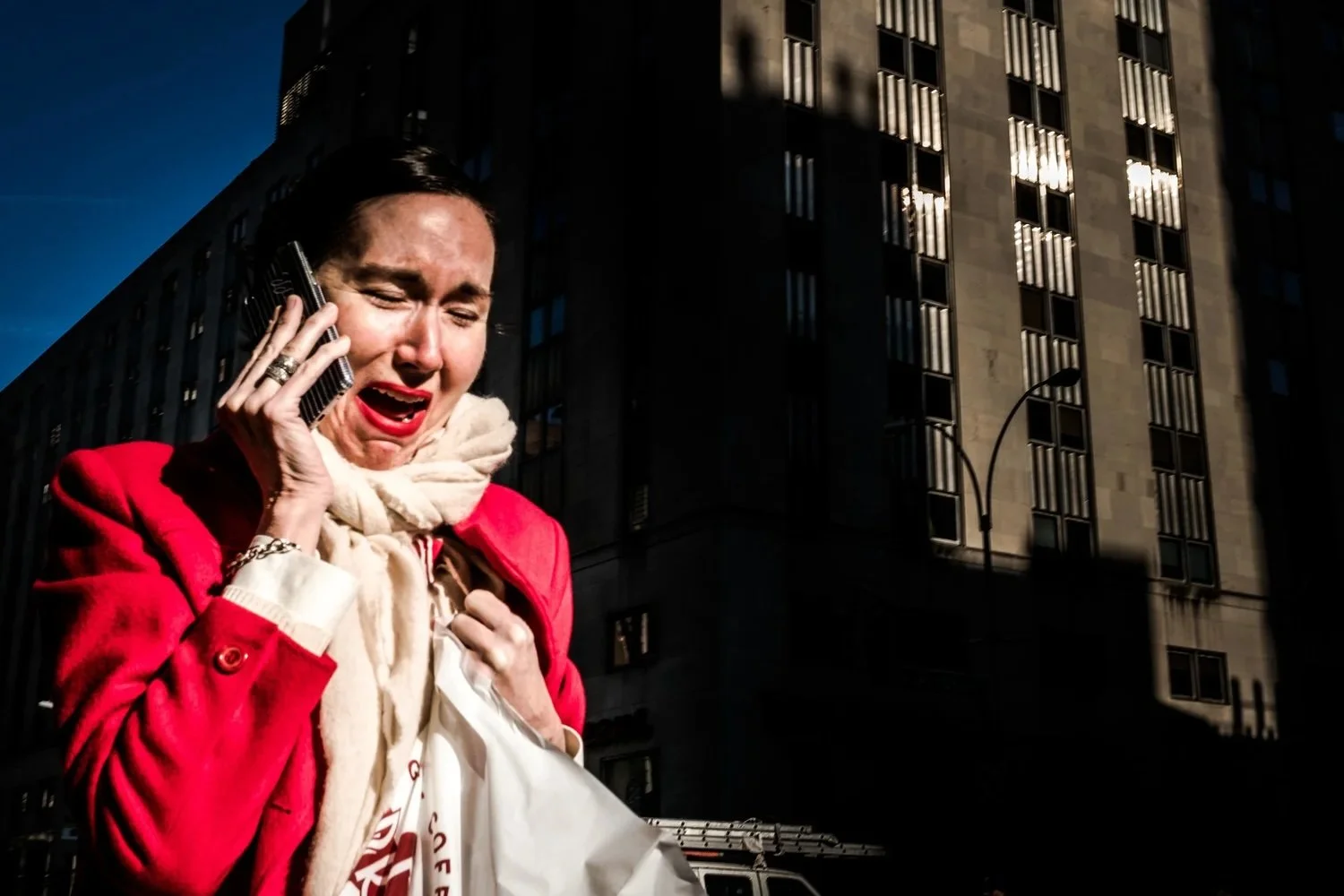
The bag in her hand says coffee. I never noticed it before. Everything else in the frame is so loud, the mouth, the eyes, the red coat, that this small detail just sat there for years going unnoticed, waiting its turn. Cheap plastic bag, a logo half turned away from the lens. Pret a Manger, I think. I've decided, and you're free to disagree, that she had just left the shop two blocks back where she ordered two coffees instead of one, out of habit, because until recently there had always been two.
The phone call, then, and that expression? Not an argument. Not crying for bad news arriving fresh,like many people assume when they see a face twisted like that. I prefer to think the bad news was old, already almost funny in the way old grief eventually gets funny with time. And that whoever was on the other end of that call had just made a joke about it, the kind of joke only two people who've been through the same thing are allowed to make, and it hit her so hard mid-sidewalk with the sun in her face that she had to stop walking, right there, right under that particular window of light..
That's the story I've given her. I have no evidence for any of it. I wasn't close enough to hear a single word, and even if I had been, I think I would have preferred not to. I like making up stories for the people I photograph more than I like knowing their real ones. The real one is theirs. The invented one, at least, is mine to keep and to tell.
What I do know is smaller and more mundane. 23rd Street runs mostly straight east to west, which means that for a narrow window most mornings, low winter sun travels straight down the corridor and hits pedestrians full in the face for a few blocks before the buildings swallow it again. I used to live east of Lexington Avenue and every morning walked west to my work. Then the sun didn't choose her. The geometry did. She just happened to be standing in the few minutes a day when that stretch of Manhattan turns into a spotlight, during my morning commute to work, a commute I made on foot down that same street for more than six years without ever once checking the math on that light.
I never checked it because checking wasn't the point. I was too busy taking pictures of the hundreds of other strangers walking the same streets, emerging from the dark of that street under rain, under sun, under a snowstorm once, under every kind of sky New York had to offer that year and the years after.
Some things are more useful left as a picture and a guess, because a fact closes a door and a guess leaves it open, and what walks through that open door is whatever the person looking at the picture decides to bring with them.
Non ero abbastanza vicino per sentirla
Mi piace pensare di custodire il suo segreto, qualcosa di invisibile agli altri. Non è così, naturalmente. Ogni cosa ormai abita soltanto nella mia mente mentre torno a osservare questo scatto a distanza di anni, seguendo quel mio solito vizio di guardare le immagini e ricamarci sopra delle storie.
Il sacchetto che ha in mano dice coffee. Non l'avevo mai notato prima. Tutto il resto nell'inquadratura è così forte, la bocca, gli occhi, il cappotto rosso, che questo piccolo dettaglio è rimasto lì per anni senza che nessuno lo vedesse, aspettando il suo turno. Un sacchetto di plastica economico, un logo mezzo girato lontano dall'obiettivo. Pret a Manger, credo. Ho deciso, e siete liberi di non essere d'accordo, che era appena uscita dal negozio due isolati più indietro, dove aveva ordinato due caffè invece di uno, per abitudine, perché fino a poco tempo prima ce n'erano sempre stati due.
La telefonata, allora, e quell'espressione? Non un litigio. Non il pianto per una brutta notizia appena arrivata, come pensano in molti vedendo un viso stravolto così. Preferisco pensare che la brutta notizia fosse vecchia, già quasi diventata buffa, nel modo in cui certi dolori vecchi finiscono per fare ridere col tempo. E che chi era dall'altra parte del telefono le avesse appena fatto una battuta su quella storia, del tipo che solo due persone che hanno passato la stessa cosa si possono permettere, e che l'avesse colpita così forte, in mezzo al marciapiede, col sole in faccia, da costringerla a fermarsi, proprio lì, proprio sotto quella particolare striscia di luce.
Questa è la storia che ho ricamato. Non ho nessuna prova. Non ero abbastanza vicino per sentire nemmeno una parola, e anche se lo fossi stato, credo che avrei preferito di no. Mi piace inventare storie per le persone che fotografo più di quanto mi piaccia conoscere quelle vere. Quella vera è sua. Quella inventata, almeno, è mia, da conservare e da raccontare.
Quello che so per certo è più piccolo e più banale. La 23esima Strada scorre tutta da est a ovest, il che vuol dire che per una finestra stretta di tempo, la maggior parte delle mattine, il sole basso d'inverno scende dritto lungo il corridoio e colpisce i passanti in pieno viso per qualche isolato, prima che i palazzi se lo riprendano. Allora abitavo a est di Lexington Avenue e ogni mattina camminavo verso ovest per andare al lavoro. Quindi non è stato il sole a scegliere lei. È stata la geometria. Si è trovata semplicemente lì nei pochi minuti al giorno in cui quel tratto di Manhattan si trasforma in un riflettore, durante il mio tragitto mattutino verso il lavoro, un tragitto che ho fatto a piedi lungo la stessa strada per più di sei anni senza mai controllare la matematica di quella luce.
Non l’ho mai controllata perché non era quello il punto. Ero troppo occupato a fotografare centinaia di altri sconosciuti che camminavano per le stesse strade, emergendo dal buio di quella via sotto la pioggia, sotto il sole, una volta sotto una tempesta di neve, sotto ogni tipo di cielo che New York aveva da offrire quell'anno e negli anni dopo.
Certe cose è meglio lasciarle a una foto e a un'ipotesi, perché un fatto chiude una porta e un'ipotesi la lascia aperta, e quello che entra da quella porta aperta è tutto quello che chi guarda la foto decide di portarsi dentro.