The Sassi and my Fever
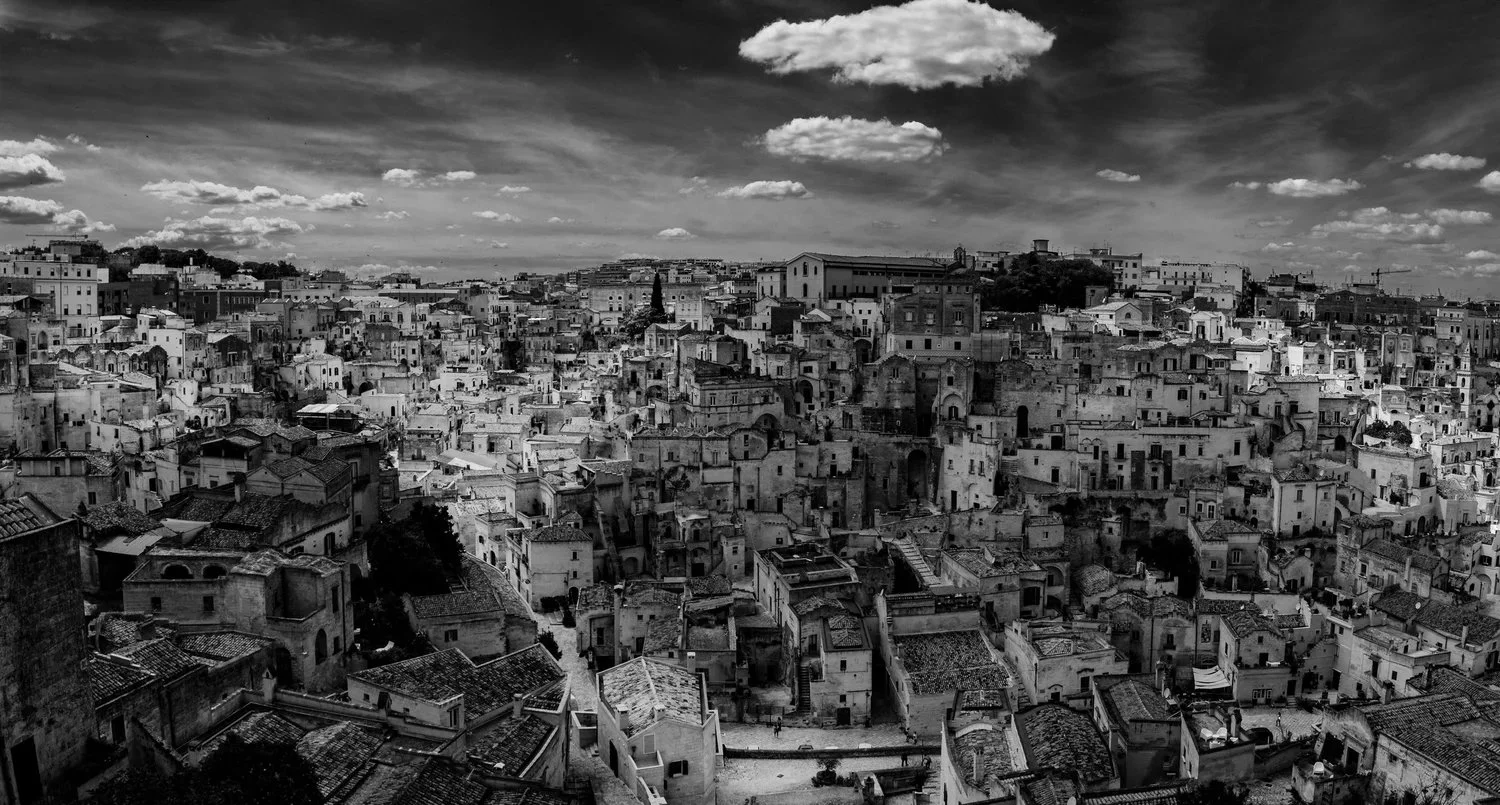
There's a light, in this photograph, that I didn't choose. It arrived on its own, one September afternoon in 2017. A light that decided which houses should emerge from shadow and which should stay buried in the stone of the Sassi, as if Matera had needed to show me something I didn't know how to read. I stood there with my camera, on a lookout point, waiting for the clouds to hold still so I could get the light exactly right. They never did.
It was one stop on our honeymoon. Jennie and I had arrived a few days earlier, still dazed by that slightly clumsy happiness of the newly married. Matera had welcomed us with its double nature, on one side the dazzling theater of the Sassi, all stone and sun, on the other a labyrinth of alleys made for getting lost in, and in which I, who came from the same country but not from that region, got lost just as much as she did.
We didn't know that the real test wouldn't be the heat or the stairs, but an intestinal virus that would pin me to bed for two days. I remember the room in that Airbnb inside the Sassi, dim, the shutters closed against an insistent sun, and Jennie going out alone to find a pharmacy in a language she didn't speak, in a country she had until then known only through my words. I've imagined her many times since, standing at a counter, miming symptoms with her hands, searching a stranger's eyes for the patience words couldn't give her. Jennie doesn't drive. And yet in those two days she drove everything else, me, the situation, our small crisis in a foreign country, with a kind of gentle stubbornness that I, healthy, might not have had.
And then, once the fever had dropped just enough for me to get back on my feet, it was my turn to take the wheel again, still weak, my hands a little unsteady on the gearshift, because the trip couldn't wait for me to be fully well. That's how you travel sometimes: not when you're ready, but when you have to be.
The photograph says nothing of any of this. It shows only the city, still and magnificent, indifferent to our small private storm. Over the years, that same image has taken paths I never foresaw: a few awards, the attention of other artists who reinterpreted it, transformed it, until it became a unique work that now lives on a wall that isn't mine, in New York, in the home of a collector who will never know anything about that fever, that pharmacy, or Jennie's hand on a wheel that wasn't hers to hold.
And yet whenever I look at it again, I don't see the city first. I see that sharp, almost unjust light, and I understand it's the same light that, a day or two before or after, slanted through a half-closed shutter onto the bed where I lay, sick, while someone outside was searching for a cure she didn't know how to ask for in that language.
I Sassi e la mia Febbre
C'è una luce, in questa fotografia, che non ho scelto io. È arrivata da sola, in un pomeriggio di settembre del 2017. Una luce che ha deciso quali case dovessero uscire dall'ombra e quali restare sepolte nella pietra dei Sassi, come se Matera avesse avuto bisogno di mostrarmi qualcosa che non sapevo interpretare. Io ero lì con la macchina fotografica, in piedi su un belvedere, che aspettavo che le nuvole si fermassero per avere la foto perfettamente illuminata. Non si sono mai fermate.
Era una delle tappe del nostro viaggio di nozze. Jennie ed io eravamo arrivati da pochi giorni, ancora storditi da quella felicità un po' goffa di chi si è appena sposato. Matera ci aveva accolto con la sua doppia natura, da una parte l'abbagliante teatro dei Sassi, tutto pietra e sole, dall'altra un labirinto di vicoli in cui perdersi, e in cui io, che pure venivo dallo stesso paese, ma non da quella regione, mi perdevo quanto lei.
Non sapevamo che la vera prova non sarebbe stata il caldo né le scale, ma un virus intestinale che mi avrebbe inchiodato a letto per due giorni. Ricordo la stanza in quel Airbnb dentro i Sassi, in penombra, gli scuri chiusi contro un sole insistente, e Jennie che usciva da sola a cercare una farmacia in una lingua che non parlava, e in un paese che fino ad allora conosceva solo attraverso le mie parole. L'ho immaginata più volte, in questi anni, ferma davanti a un bancone, a mimare sintomi con le mani, a cercare negli occhi di uno sconosciuto la pazienza che le parole non potevano darle. Non guida, Jennie. Eppure in quei due giorni ha guidato tutto il resto, me, la situazione, la nostra piccola crisi in un paese straniero con quella sua testardaggine gentile che io, sano, forse non avrei avuto.
E poi, quando la febbre è scesa quel poco che bastava per rimettermi in piedi, sono stato io a dover riprendere il volante, ancora debole, le mani un po' incerte sul cambio, perché il viaggio non poteva aspettare che io stessi bene del tutto. Si viaggia anche così, a volte: non quando si è pronti, ma quando bisogna esserlo.
Di tutto questo, la fotografia non dice nulla. Mostra solo la città, immobile e magnifica, indifferente alla nostra piccola tempesta privata. Con gli anni, quella stessa immagine ha preso strade che io non avevo previsto: qualche premio, l'attenzione di altri artisti che l'hanno reinterpretata, trasformata, fino a farne un'opera unica che oggi vive su una parete che non è la mia a New York, in casa di un collezionista che di quella febbre, di quella farmacia, della mano di Jennie sul volante che non era la sua, non saprà mai nulla.
Eppure io, ogni volta che la riguardo, non vedo prima la città. Vedo quella luce netta, quasi ingiusta, e capisco che è la stessa luce che, due giorni prima o due giorni dopo, era entrata di taglio da una persiana socchiusa sul letto dove ero disteso, malato, mentre qualcuno fuori cercava per me una cura che non sapeva chiedere in quella lingua.